
 AI Inspiration World
More images
What it is
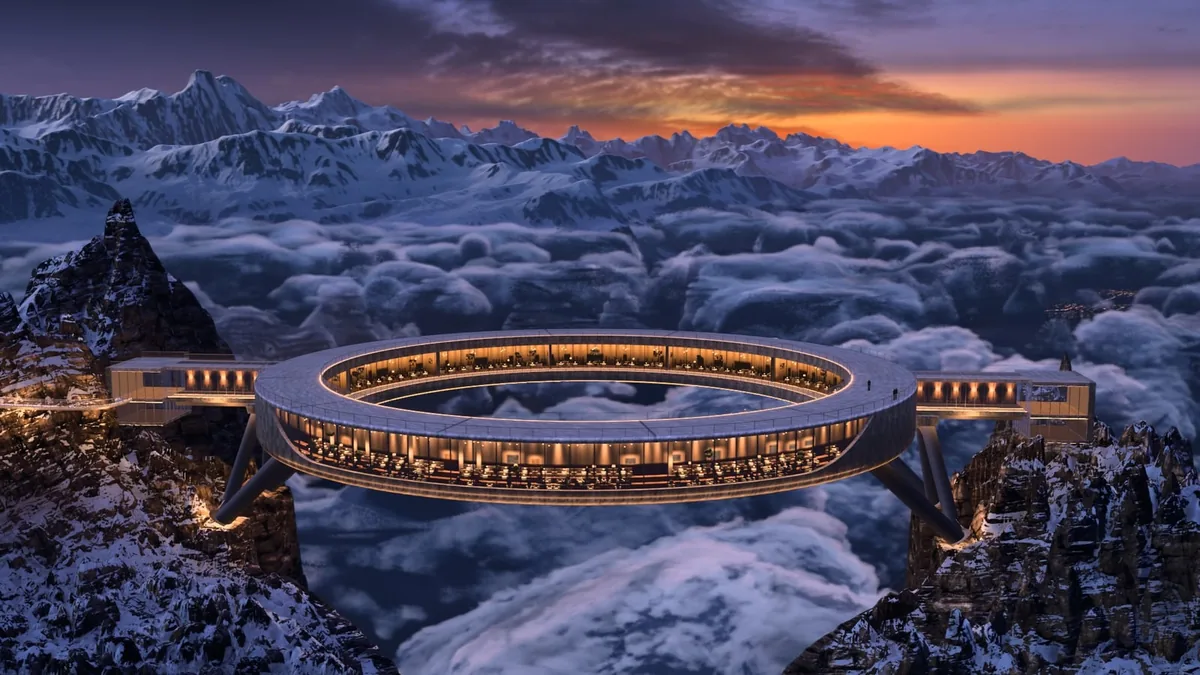
Halo Above the Clouds is an open-source 3D scene by GitHub user Leonxlnx. It shows a concrete ring restaurant hanging between two snowy dolomite pinnacles at blue hour, above a sea of clouds, with Lake Brienz and the Bernese Alps below. It is a real-time Three.js (r187, WebGL2) scene, and the README says a 45 s drone film was rendered offline from that same scene. After you run it locally, you can orbit and zoom with the mouse in your browser, or jump between camera views with keys. The README says the scene was built by Claude Code (Claude Opus 5.5) from 11 AI-generated reference images, with several agents working in parallel on terrain, rock and snow, clouds, sky, structure and the film. Every frame of the film is rendered from the 3D scene, and the film does not use reference-image projection. What makes it special is that one scene works both as a real-time viewer and as the source of a film.
Highlights:
- The terrain uses real elevation data around the Brienzer Rothorn (46.787 N, 8.047 E)
- The ring is 110 m across, with a roof deck, a glazed restaurant ring with an inner terrace, and V-struts
- The cloud sea is drawn with a volumetric raymarch, the valley has about 117k village and road lights, and the lake has reflections
- The film is made of 11 free-flight shots with a fade-in and a fade-out
How to use:
- First, install Node 22.12 or later, run `npm install`, then run `npm run data` to download the scene data.
- Then run `npm run dev` and open http://localhost:5173 in your browser; the first load can take a few minutes.
- Finally, drag to orbit, scroll to zoom, press 1 to 9, 0 or − to jump to camera views, and press V to play the film's camera path in real time, then press it again to stop.
Who it's for:
People who want to see a real-time Three.js scene, or see what Claude Code can build in 3D.
Before you start:
- You need Node 22.12 or later and a GPU with WebGL2, and you view the scene in a web browser; on a weaker GPU, add `?noclouds` to the URL.
- `npm run data` downloads about 0.3 GB of scene data into `data/`.
- To render the film yourself, you need headless Chrome (driven through `puppeteer-core`; the README sets it up for Chrome on Windows, and elsewhere you set `CHROME`), `ffmpeg` with libx264, and PowerShell for the encoding script. The author says that at K 8 a frame took about 5 s on a laptop Radeon 780M, so roughly 2 h for all 1350 frames.
- The reference images are not in the repo; the tools that compare against them need your own images in `ref/`.
- The code is in a public repository.
- The code license is MIT. Textures and sky HDRIs come from Poly Haven (CC0), the film music "Uprising" by Scott Buckley is under CC BY 4.0, and the elevation data comes from AWS Terrain Tiles.
Based on the project's public documentation. Not tested by AI Inspiration World.